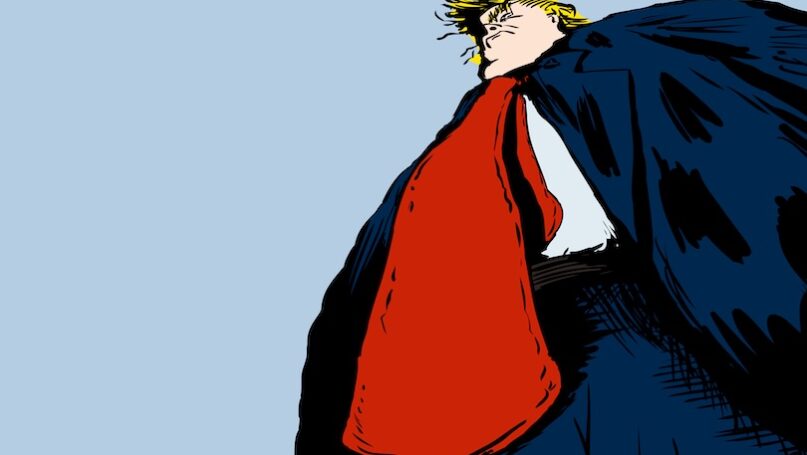
In contemporary liberal democracies, the distinction between what counts as ordinary political activity and what belongs to the realm of exception has grown increasingly difficult to discern. What once appeared as a temporary disruption of the democratic order now becomes part of the field in which decisions are made. The exception is no longer an external event but a condition that shapes ordinary political activity. Carl Schmitt’s thinking is useful in this context because he defines sovereignty as the capacity to decide when existing procedures no longer organise conflict and when a direct intervention becomes necessary. When institutions fail to produce clear outcomes, the actor who claims the authority to define the situation occupies a distinct position. This becomes tangible with Donald Trump, who operates in this space by treating institutional friction not as something to correct but as evidence that only decisive action can restore political clarity. As confidence in procedural order weakens and perceived institutional legitimacy declines, this modality presents itself as a plausible response to the current crisis of liberalism. In this configuration, the boundary between ordinary administration and the perception of disorder blurs, and the decisive act returns as an available instrument rather than an exception held at the margins of constitutional life.
This dynamic is central to Schmitt’s argument in Political Theology (1922), which shows that legal orders rest on conditions that can fail. He notes that legal norms depend on circumstances that can collapse, and that every legal order presupposes the possibility of suspension when such a collapse occurs. The force of the norm is to presuppose a power capable of deciding its suspension. However, when interruptions reappear with regularity or settle into routine practice, the meaning shifts and they begin to reveal tensions that usually remain concealed in democratic systems. His reading of Article 48 of the Weimar Constitution shows how emergency provisions designed to protect the constitutional order can begin to reshape it once their use becomes recurrent (De Wilde 2010). In this context, legality continues to operate in form while sovereignty leans toward the actor who decides when the exception applies. For Schmitt, the point is that this vulnerability lies inside the constitutional order itself, and no institutional design can fully resolve it. Mechanisms conceived to stabilise the system in exceptional moments also possess the capacity to transform it when invoked without restraint. The question becomes whether the exception remains contained or whether it begins to condition the wider political environment.
Donald Trump openly combines a variety of registers to install a dynamic of permanent motion that cuts through institutional inertia. The signature elements of his governing style are executive orders, administrative instructions, improvised announcements and confrontations with institutions or political opponents. This continuous movement blurs the line between ordinary procedure and exceptional intervention. It provides him with room to manoeuvre because it allows political actions to be framed as responses to immediate challenges. The counterpart is that it creates a political environment where uncertainty becomes normal. Repetition of the exceptional decision gradually turns the decisive act into a force capable of organising the political environment, pulling political practice away from the deliberative expectations of democratic life. This echoes what Debord describes in The Society of the Spectacle (1967 / 1994) because appearances organise political relations and institutions operate within the space that perception creates.
Staging a state of permanent crisis, even when it is assembled from partial signals, shapes how institutions understand their position and how they position themselves within the political order. The performative action deliberately blurs the line that once separated routine from rupture. It forces institutions into interpretative judgement, and they must adjust to it as best they can. A statement delivered without preparation can redirect legislative priorities before any formal process even begins because institutions react to the signal rather than to its legal substance. Agencies move not because of the content itself but because the performative act, even in minimal form, alters their perception of what demands attention. In this configuration, the decision acquires force not through formal justification but through visibility, timing and the reactions it produces. What matters is not the legal status of the announcement but the perception that a shift has already taken place.
There are multiple examples across Trump’s two presidencies that make this dynamic visible inside administrative practice. The February 2025 memorandum directing federal agencies to review and suspend funding to organisations designated as harmful to the national interest is one of the clearest because it redraws the limits of civic activity without using the vocabulary usually associated with emergency politics. The manoeuvre is deliberately subtle. Without being clearly defined, the adversary emerges through classification in administrative acts rather than through open designation. In this context, sovereign practice is cloaked inside routine administrative procedure. The use of broad criteria such as what counts as harmful to national interest widens the interpretive latitude across the administrative chain. The executive sets the frame while agencies inhabit it. They are forced to recalibrate their priorities because the framework requires interpretation even in the absence of explicit instruction. This interpretive burden generates disorganisation because institutions must act without a stable point of reference. The register of action shifts toward crisis while no crisis is declared, allowing sovereign authority to alter the scope of state activity below the threshold of public attention. In Schmitt’s terms, sovereignty becomes most visible when the state redefines its operational boundaries under the appearance of normal procedure, and that is what is happening here. The memorandum operates in this way. It avoids confrontation, avoids emergency language, and recasts federal engagement with civil society through administrative adjustment.
Under these conditions, institutions struggle to maintain their own pace. Their reactions arrive after political effects have already begun to unfold. Posner and Vermeule (2013) describe this temporal disadvantage, a situation where institutions act but always slightly too late. Their intervention comes only after the decisive act has already set the direction. The performative nature of the decisive intervention places them in a permanent reactive posture. Trump’s use of social media is an illustration. Decisions are made public before agencies are consulted, and this reconfigures the political order of time. The result is that deliberation loses space while the executive occupies the moment. Within this presidential framework, institutions are left to manage consequences rather than shape decisions. Power operates through timing as much as through content. Control of timing reshapes the field in which institutions act. Each acceleration produces a precedent, and as urgency repeats, institutions whose legitimacy relies on slower deliberative procedures find it increasingly difficult to assert influence. What follows is a reversal of the usual order. Their caution becomes a liability. Their authority weakens as decisions have already taken effect. They are neutralised and must adapt after the fact. This temporal asymmetry gives the presidency greater room to impose its direction.
As temporal asymmetry deepens and institutions operate in a reactive posture, the exception no longer appears as a sudden rupture. It actually settles into practice. When the exception ceases to function as an isolated event and becomes a structure of action, Schmitt’s understanding of what marks the sovereign takes on a different relevance. His claim that the sovereign is the one who decides on the exceptional situation is not an abstract point. It shows that the constitutional orders of contemporary liberal democracies depend on a power that the order itself cannot fully contain. The decisive act makes this dependence visible. It reveals that political systems rely on figures capable of initiating movement when institutional routines drift toward lethargy. And when decisions of this kind recur across different settings, they become a method rather than an interruption. Schmitt’s Dictatorship (1921 / 2013) distinguishes between two forms: the commissarial register, which aims to preserve the existing order, and the sovereign register, which aims to redefine it. Trump moves between these two positions, and this movement makes the exception difficult to situate within familiar liberal categories.
The commissarial register appears when Trump invokes a threat to justify the temporary suspension of procedure. The 2017 travel ban is part of this logic, as do many decisions framed around national security, immigration, terrorism, public health, civic disorder or economic instability. What gives these moves their force is not the substantive content of the threat but the act of naming it, a dynamic contemporary political theorists describe as securitisation (Buzan, 1998). In Schmitt’s framework, naming the threat already counts as an exercise of sovereign authority because it defines the situation to which the system must adjust. Once the threat is designated, agencies have little choice but to shift into a crisis posture. Their response follows the executive’s interpretation even when nothing in the underlying conditions has altered. The commissarial stance works by presenting preservation as urgency. It signals that procedure must yield, though only for the duration of the disturbance as defined by the executive. The effect is to concentrate authority while maintaining the appearance that the order itself is being defended.
The sovereign register, by contrast, operates in a broader field. It appears when measures do not aim to preserve the existing order but to redefine who belongs within it. Trump’s contestation of the 2020 election falls directly into this space, and the 2025 memorandum does as well. These moves work by reshaping the boundary of civic legitimacy. Internal actors such as journalists, bureaucrats, experts, governors, NGOs and judges can be recast as adversarial forces. The friend–enemy distinction that Schmitt develops in The Concept of the Political (1932 / 2007) becomes part of ordinary democratic vocabulary and gradually turns into an organising line of political life. Sovereign authority functions here not only by suspending norms but by deciding which actors count as part of the political community. It operates as a discursive reframing to which institutions have only limited and asymmetrical capacities of response. As the boundary of civic legitimacy becomes less precise, the stabilising mechanisms of the constitutional order lose part of their functional effectiveness.
With Trump, the movement between commissarial and sovereign forms develops gradually. It takes shape through statements, administrative postures, confrontations and interpretative moves that accumulate over time. This accumulation allows the exception to settle inside ordinary political moments. Trump operates with the intuition that the American constitutional system, with its layered checks and dispersed procedures, struggles to produce a clear decision. He presents the decisive act as the remedy to this structural difficulty, casting the presidency as the point from which political direction can legitimately arise. The effect is to draw the exception toward the centre of political life, concentrated in the figure of the president. When institutions appear fragmented or hesitant, the decisive act is framed as the only available source of direction. As this pattern repeats, procedural normalcy erodes. Political authority begins to arise less from formal processes and more from the capacity to confront, to define the situation and to impose movement.
To understand how this shift becomes a shared political experience, returning to Debord provides the right lens. In a media environment where perception carries immediate political weight, the visible act produces expectations of its own (Edelman, 2013). Trump works within this logic. Whether it is press events, public confrontations, improvised announcements or accusations against internal adversaries, all of it sustains a climate of permanent disruption, by intention or by habit. Their impact does not come from legal form. It comes from how they are framed and when they are delivered. Under Trump, sovereignty and representation converge, and the logic of the exception enters everyday political life. Each day carries the possibility of rupture because these moves generate anticipatory reactions that institutions cannot avoid.
This environment reinforces patterns of identification because every public move generates an immediate interpretive response. Once Trump casts institutions as hostile, the reaction loops back into the political sequence. Investigations are read as persecution. Criticism functions as confirmation. And it becomes difficult not to see that this dynamic follows Schmitt’s logic of association and dissociation, where the friend–enemy line gradually becomes the organising pattern of political life. The field tightens and the distance between disagreement and hostility narrows. Opposition turns into systematic enmity. As this pattern unfolds, actors begin to recognise one another through the positions they occupy in this confrontation rather than through the roles assigned by institutions. The result is a political setting that drifts away from moderated disagreement and toward a space where identity and conflict are tied together.
Trump’s approach differs from leaders who institutionalise the exception through formal legal structures. Hungary and Poland have folded emergency powers into ordinary law, building the exception directly into the framework (Drinóczi, 2020). Trump moves differently. He works through atmosphere and pace. He creates a setting where crisis appears imminent without codifying any extraordinary powers. It becomes a stage where sovereign authority operates through visible actions and administrative adjustments rather than through explicit legal change. The spectacle makes authority perceptible, and the exception provides the rationale. As these two elements reinforce each other, the line that once separated institutional procedure from political performance grows thinner.
In democratic systems, rules organise expectations and give political life its continuity. On the contrary, the decisive act disrupts these patterns. Trump leans into this disruption, turning unpredictability into a governing method. In a political environment where institutions rely on stable routines to assert their role, unpredictability makes them lose their footing. Supporters interpret it as autonomy, as proof that he refuses constraint. And the more turbulence he generates, the more indispensable he appears, even when he is the source of that turbulence. The effect is to push institutions toward the margins, although they once provided the structure through which the system functioned. Voluntarily or not, the outcome is a reset of the democratic order, shifting it from an institutional framework to a logic centred on the sovereign figure. In this frame, the elected president can present himself as the point where the will of the people and the sovereign moment converge, which then gives a form of legitimacy to exceptional governance by grounding it in the claim to embody popular interest.
The exception gradually becomes a way to read political life. Obama attempted to restore procedural normalcy after the financial crisis. Biden tries to stabilise institutional pace after 2020. But Trump interprets these moves not as efforts to rebuild order but as obstacles placed in the way of decisive action. He recasts normality as something deployed against him. He presents procedure as a mask for inaction. He implies that sovereignty can only be exercised against the mechanisms meant to regulate it. This marks a real shift. It is not simply that he sets himself against the institutional framework. It is that, in his narrative, the framework itself blocks the exercise of what he describes as the people’s will. It renders his capacity for action ineffective despite being the elected representative. And once this claim settles, the reshaping of institutions appears legitimate, while decisive action becomes the expected mode of governance. In this environment, institutions come to embody inertia, and even small administrative gestures can recalibrate expectations. A shift in allocation, a directive, or pressure applied to an agency is enough to alter implicit norms across the system and to trigger movement.
As this dynamic expands, the distinction between commissarial and sovereign forms becomes a useful way to understand how politics reorganises itself. One register rests on temporary necessity. The other rests on redefinition. Trump moves between the two with unusual fluidity. He can begin in a commissarial mode, invoking the need for urgent protection, and conclude in a sovereign mode, promising to rectify a political order he presents as corrupted. The shift occurs within the same sentence. And it is this movement that blurs categories that once helped observers interpret political behaviour. When these categories lose sharpness, executive power finds new space to advance. It enters areas once guarded by institutional constraint and presents this expansion as the natural consequence of the moment.
The result is a form of democracy where stability no longer follows automatically from procedure but requires continuous political upkeep. The issue is not only the possibility of suspended rights. It is also the erosion of the reference points that once marked the boundary between routine governance and its interruption. Schmitt and Debord each illuminate one side of this shift. Schmitt draws out the weight of the decisive act, while Debord draws out the power of its visibility. In Trump’s practice the two converge. A decision must appear in order to operate, and appearance depends on timing. Once these elements reinforce one another, the exception no longer arrives as an isolated moment. It becomes a background condition of political life, something that accompanies the ordinary rather than something that stands outside it.
Beyond the United States, the same pattern reveals how fragile contemporary democracies have become. Their stability depends on shared conventions that mark the line between routine and crisis, between procedure and decision. These conventions rest on trust, and when trust erodes, the confidence that holds the system together weakens with it. Decisive actions then move to the foreground. They are often described as populism, but the movement actually runs far deeper. It does not signal a simple return to older authoritarian forms but point instead to the limits of a political model that relies on conventions more than on binding constraints. The crisis sits beneath constitutional design and beneath institutional architecture. It produces the sense, increasingly common across democratic settings, that institutions no longer give direction but only produce inertia. The problem is that once that perception settles, it opens space for methods of governance built on direct action, on the figure who claims to move where institutions hesitate.
Trump’s trajectory forces contemporary democracies to confront something they often prefer not to acknowledge. Sovereignty does not disappear under procedural arrangements. It remains latent and becomes active the moment institutional confidence weakens. The challenge lies in whether a political culture exists that can contain this activation. Political culture here rests on shared limits, on the normative sense that certain disruptions remain unacceptable even when the law technically allows them. It rests on a collective disposition to treat conflict as political rather than existential, disagreement as ordinary rather than as betrayal. It requires institutions whose legitimacy draws as much from recognition as from rule. When this culture dissolves, when actors begin to treat institutions as obstacles rather than as frameworks, when the logic of the exception becomes ordinary, legality no longer offers protection. The decisive act cannot simply be undone. It must be absorbed, domesticated, made compatible with an order that still claims to rest on regularity. And once this political culture erodes, law by itself is unable to sustain democratic order. Democracies persist not by removing sovereignty but by preventing its capture by figures who treat public authority as the extension of their personal will.
References
De Wilde, M. (2010). The state of emergency in the Weimar Republic Legal disputes over Article 48 of the Weimar Constitution. The Legal History Review, 78(1-2), 135-158.
Buzan, B., Wæver, O., & De Wilde, J. (1998). Security: A new framework for analysis. Lynne Rienner Publishers.
Debord, G. (1967 / 1994). The Society of the Spectacle. Zone Books.
Drinóczi, T. (2020). Hungarian abuse of constitutional emergency regimes–Also in the light of the COVID-19 crisis. MTA LAW WORKING PAPERS, 7(13), 1-26.
Edelman, M. (2013). Politics as symbolic action: Mass arousal and quiescence. Elsevier.
Posner, E. A., & Vermeule, A. (2013). Inside or Outside the System. University of Chicago Law Review, 80, 1743–1780.
Schmitt, C. (1922 / 2005). Political Theology: Four Chapters on the Concept of Sovereignty. University of Chicago Press.
Schmitt, C. (1932 / 2007). The Concept of the Political. University of Chicago Press.
Schmitt, C. (1921 / 2013). Dictatorship. Polity Press.
Further Reading on E-International Relations
- State of Exception? When Theory Meets Its Walls: A Rejoinder
- Opinion – Trump, Race and International Politics
- An Ecological State of Exception: Applying Carl Schmitt to Climate Change
- Opinion – Trump’s Cairo Roast and the Performance of Populism
- Opinion – Trump’s Spectacle of Domination in Venezuela
- The Paradox of Trump 2.0