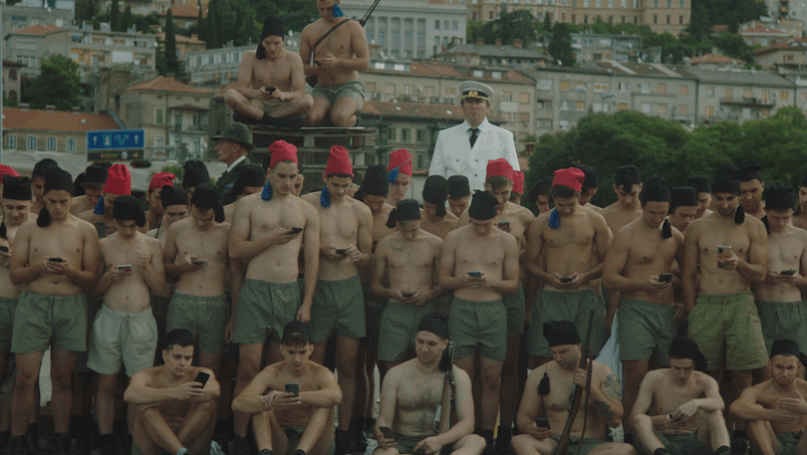
Fiume o Morte!
Directed by Igor Bezinović, 2025
Fiume o Morte (“Fiume or death”) was the slogan of Gabriele D’Annunzio, the flamboyant Italian poet, nationalist and war hero whose cult of personality helped propel him to lead the occupation of the Adriatic port city of Fiume (now Rijeka) in 1919. Igor Bezinović’s documentary Fiume o Morte revisits this politically charged period through an inventive blend of reenactment, street interviews, and archival material. Far from a conventional historical documentary, it is vivid, irreverent, and frequently very funny, using humour to disarm the viewer while encouraging reflection on the construction of myth, nationalism, and history. As Michael Ledeen observed, “[a]n analysis of D’Annunzian Fiume goes a long way toward accounting for much of the puzzling political behaviour that has characterized Western society ever since the Great War” (Leeden, 1977, vii). The film embraces absurdity as a critical tool, drawing attention to the theatrical and performative nature of political power. Its reception has differed sharply — while attracting little attention in Italy, it has been praised in Croatia and selected as the country’s submission for the 2025 Academy Award for Best Documentary. This contrast already highlights one of the film’s central themes — that history is settled but contested, claimed and resisted across borders and generations.
The historical events at the heart of the film are complex. The 1919 Paris Peace Conference placed the strategically significant Fiume within the newly formed Kingdom of Serbs, Croats and Slovenes (later Yugoslavia). Italian nationalists opposed the decision, and a group of disaffected elite Arditi soldiers, refusing demobilisation, invited D’Annunzio to lead an armed expedition to seize Fiume in defiance of international diplomacy and the Italian government (Leeden, 1977). Initially welcomed by much of the Italian-speaking population, D’Annunzio soon imposed an increasingly authoritarian regime. He introduced a strict but often bizarre code of conduct for his troops that demanded excellence in everything from running and tree-climbing to imitating humans and animals — reenacted in the film with deadpan humour that exposes the absurdity of militant spectacle. He targeted non-Italian businesses and institutions, promoted racist hostility toward Slavic communities, and framed politics in starkly exclusionary terms that demanded absolute loyalty, reflecting a worldview steeped in cultural chauvinism and emerging fascist tendencies.
In December 1919, the Italian government proposed a modus vivendi to resolve the Fiume question, which would recognise the city’s desire for annexation, following earlier attempts to end the standoff through a naval blockade of the port. Although D’Annunzio initially accepted the idea, he urged the population to reject it. A vote was organised, but when it became clear that support for his position was limited, he sent troops to disrupt the ballot and nullified the result on the grounds of the violence he had orchestrated. The documentary reconstructs this moment, noting that no photographs of the disruption survive despite the regime’s own Photography Section. The filmmakers restage the scene using actors and newly created still images, drawing attention to the gaps and manipulations of the historical record.
The crisis escalated in September 1920 when D’Annunzio proclaimed the Italian Regency of Carnaro and introduced the Charter of Carnaro as its constitution. Co-written with the syndicalist Alceste De Ambris, the charter blended radical social provisions (universal suffrage, workers’ councils and protections for women) with a celebration of war as a moral necessity and a strict hierarchy of citizenship. The occupation reached its violent climax during “Bloody Christmas” in December 1920, when D’Annunzio declared war on Italy, prompting an attack by the Royal Italian Army. The film depicts this phrase in a stark tonal shift with close-ups of actors lying motionless to symbolise the twenty-two killed. The grim stillness contrasts sharply with earlier absurdity, underscoring the lethal endpoint of performative politics. These events combine to reveal the proto-fascist character of the Fiume experiment, admired by Mussolini and foreshadowing many elements of later fascist rule (Leeden, 1977).
Bezinović’s approach to retelling this history is inventive. Local residents of Rijeka portray soldiers, officials, and D’Annunzio himself, bringing personal narratives to the reenactments. In one scene, a musician plays D’Annunzio in a dispute with an Italian general before joining his rock band to greet the trucks representing the arrival of soldiers’ vehicles. The filmmaking process is deliberately visible, incorporating casting conversations, improvised lines and unscripted street encounters. Archival photographs are juxtaposed with recreated images. In one memorable sequence, a photograph of a group of soldiers sitting on the docks is followed by a modern version of the same pose, except the actors are focused on their phones. The effect is both comical and revealing, highlighting the banality underlying heroic historical narratives.
Humour is also used to interrogate political charisma. In one scene, a Rijeka resident reenacts D’Annunzio’s famous balcony speech (later imitated by Mussolini, along with the Roman salute) with a handful of clapping supporters next to him. The camera pulls back to reveal an otherwise empty street before cutting to an archival photo of the original speech delivered to a crowd-filled street. These careful visual contrasts make visible the mechanics of spectacle and show how authority is constructed, rehearsed, and amplified by visual framing. Such humour, which risks trivialising history, functions here largely as critical engagement. By exposing the theatrical nature of political authority and puncturing the solemnity that often surrounds nationalist myth, the film uses humour in a way that aligns with Simon Critchley’s (2002) account of humour as an ethical mode of resistance that challenges unearned reverence and disrupts the performance of power without falling into cynicism.
Although focused on the political mythology surrounding D’Annunzio, the film also gestures (albeit lightly) towards the social dynamics of occupation. Women often appear in supporting or fleeting roles, including as one of the narrators and a hotel worker tending to a feverish D’Annunzio. These roles, limited in scope but notable in presence, suggest a conscious effort to include women in a narrative space where they are often overlooked. Bezinović does not attempt to revise history by artificially elevating these characters, but instead subtly draws attention to the gendered silences in nationalist histories, where women are frequently positioned at the margins of political action (Yuval-Davis, 1997). These brief appearances also hint at the social realities behind the heroic myth — the everyday labour, care and survival that sit beneath military spectacle.
The most incisive achievement of Fiume o Morte lies in its critique of nationalist myth-making. Rather than condemning D’Annunzio through moralism, Bezinović uses irony to deflate the self-mythologising that has long surrounded him. By revealing the staged nature of his politics — his balcony speeches, grandiose declarations and theatricalised public rituals — it shows that nationalist myths are not only ideological but aesthetic constructions (Falasca-Zamponi, 1997). The film’s attention to local language and identities, particularly the Fiuman-speaking community and their understanding of the occupation, highlights how cultural identity shapes historical interpretation. Filmed on location in Rijeka at former sites of occupation, it creates a dialogue between past and present, resisting any single, authoritative historical narrative. The use of local actors and dialects foregrounds the plurality of memory, showing how history is continuously negotiated rather than settled. In this sense, the film challenges nationalist nostalgia, not by dismantling it in abstract terms, but by exposing the multiple, often conflicting meanings Fiume still holds for those who live there.
Fiume o Morte succeeds because it balances humour with historical insight, participation with critique, and spectacle with reflection. Its hybrid format — re-enactments, archival photographs, interviews, and oral narration — illuminates the entanglements of nationalism, collective memory, and myth, while demonstrating how ordinary people become actors in historical events that might otherwise seem remote or abstract. The film also confronts the unresolved legacies of Fiume and of D’Annunzio himself. He was still rewarded with the title of Prince of Montenevoso by the Italian state, and monuments to him still stand in Italy, reflecting a contested memory that continues to divide opinion. By combining laughter with analysis, the film invites audiences to engage critically with the politics of memory. For scholars and students of European history, nationalism, political myth, memory, visual politics and performance, as well as general audiences, Fiume o Morte offers an inventive, witty, and thoughtful exploration of a historical episode whose political and cultural legacies continue to provoke debate today.