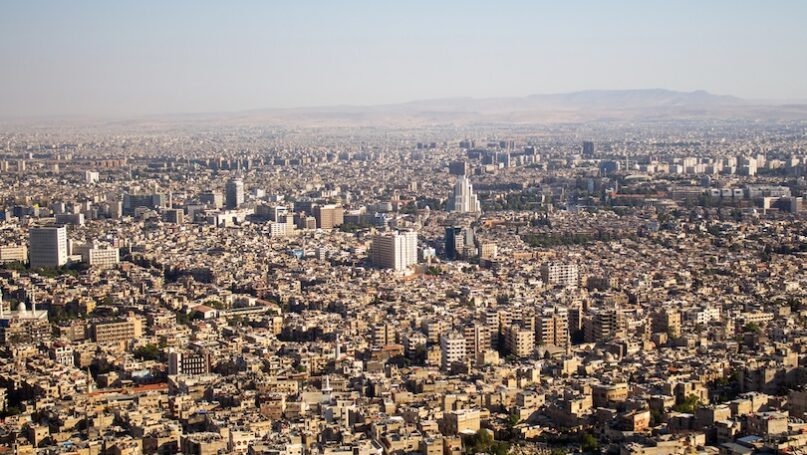
Syrians marked the anniversary of the regime’s fall not with a clear sense of having reached a common destination, but with a dispute over horizons. More than a decade of revolt, war, foreign intervention and institutional collapse has not produced a shared language for politics so much as a clash of grand narratives about what Syria is and where it must go. In that sense, Syrian politics today looks like a frontline of totalising projects, competing to own the future in the name of the nation, the revolution, or the country.
Grand narratives after the fall
Jean-François Lyotard notably defined postmodernity as incredulity towards metanarratives, driven by a loss of trust in large, all-encompassing narratives promising progress and emancipation, or defining a nation and its subjects (Lyotard 1994). The term signified the systematic interrogation and suspicion of grand narratives after the Second World War in Europe, where competing metanarratives defined modern politics and led to the war. Although metanarratives have not lost their appeal to the masses, postmodern criticism has opened horizons for new political opportunities in Europe and, more generally, in the Western world. In Syria, however, since the fall of the regime, politics has been moving in the opposite direction despite a similar tragedy. In the vacuum left by Ba’athist rule, actors have rushed to establish new master frames(McGowan 2018), which promise a brighter future and a final solution for all.
The anniversary celebrations showcased various and competitive horizons for the country. In Damascus and other cities under the transitional administration, official rallies, mosque sermons, and media coverage blended a language of Islamic moral renewal and Arab nationalism with discussions of institutional democratisation, portraying the fall of Assad as the start of a five-year journey towards a just, representative state that ‘befits the sacrifices’ of the people. The crowds, flags, and carefully curated chants were not just catharsis; they were a way to show that their synthesis of Islam, nation and ballot box now anchors Syrian political legitimacy.
In the northeast, where the Autonomous Administration of North and East Syria (AANES) has its own institutions and history of struggle, smaller, more controlled events and official statements frame the anniversary as another milestone in a longer fight for a ‘unified, democratic and decentralised Syria’ that recognises all its peoples and honours the battles against ISIS. Even when the administration restricted large public gatherings in the name of security, the leadership used speeches and written messages to emphasise that any true liberation must include radical democracy, gender equality, and recognition of Kurdish and other minority rights.
For the Druze in Suwayda, the regime’s collapse removed long-standing repression, yet it also opened the gates to new security risks from the transitional government, especially after the alarming attacks on the region in July 2025, when the central government sought to control the region by force. Therefore, the commemorations emphasised community protection and local autonomy, framing ‘liberation’ not as a finished story with the fall of the regime but as a new phase for the struggle to achieve security and recognition for autonomy within any future Syria.
In the Alawite-populated coastal region, the anniversary was more ambivalent. Although people quietly welcomed the end of a war that had consumed their community, they also saw the date as the moment their own world became more precarious. Reports of deadly clashes in March 2025 between former regime loyalists and forces of the transitional government, which later evolved into the securitisation of the Alawite community, left many Alawites fearful of marginalisation. Therefore, local people tended to emphasise calls for coexistence, guarantees of minority rights, and protection from collective punishment, in contrast to the triumphant language heard in the capital.
The projected hopes and wishes reflected in narratives depict a Syria that is post-Assad and Ba’ath but not post-metanarrative. Instead of Lyotard’s ‘incredulity toward metanarratives,’ actors across the country cling to and seek new overarching stories: Islamist moral renewal, centralised government, democratic autonomy, decentralised governance, and communal protection. Each signifies past sacrifices, depicts a path to a brighter future for the country, and settles all matters. The anniversary of the regime’s fall reveals how the present is continually devalued, regarded as an interim ‘phase’ whose sole significance lies in its approach to a stable horizon. At the same time, the diverse, conflicting local experiences of Suwayda, the Alawite coast, AANES areas, and the central belt are pushed back under the umbrella of competing grand visions.
The seduction of macro politics
Such a fixation on the macro level is understandable given that a society traumatised by armed conflict, destruction, and displacement seeks a story in which history finally moves towards justice. The promise of a future that prevents the situation from getting worse, heals the wounds, and makes the sacrifices made meaningful acts as both an emotional anaesthetic and a political compass: it allows elites to claim that today’s costs, compromises, and challenges are necessary steps on a long march. A crucial point is that one also must not exclude the elites from such fixation. It is an ideological ground and a frame of meaning that is shared across the board. In this sense, the Syrian case resembles the European interwar period, where competing grand narratives after WWI about the future, between Nazis, communists, and liberals, all claimed to embody a complete vision of modernity and its endpoint, a moment in the future that settles all matters, thus ending history.
Macro politics has a price. The overarching story of the Ba’athist narrative, which emerged during the interwar period in Europe, steered the country towards injustice, corruption, and finally armed conflict, ironically under the banners of Unity, Freedom, and Socialism. It testified that when politics is portrayed as a march towards an ultimate horizon, the messy, detailed work of the present is devalued. The daily suffering of Syrians, corruption, poverty, lack of freedom, and humiliation, was dismissed when the grand ideals mattered most. Every day challenges were deferred to a future until they became unbearable, thus leading to the conflict that devastated the country for over a decade, starting in 2011.
In the dominance of grand narratives, issues such as transparency, accountability, pluralism, gender equality, the balance of power, institutional justice, or even basic questions of safety at checkpoints become minor details, always subservient to the ‘big picture.’ Anything that does not obviously align with the master narrative can be dismissed as secondary, immature, or even as sabotage to the cause.
Micro politics as background noise rather than core content
The diminishment of local governance has been evident throughout the Syrian landscape after the fall of the regime (Fakhoury 2025). Before the regime’s fall, the opposition groups regarded local councils as tools to practice governance, to harness political and international legitimacy, and to showcase their governance skills. Once, a point was strongly conveyed by the Islamic State during its heyday in 2014 and 2015 (Todenhöfer 2016). The assertion of the centralised government embodying revolutionary ideals after the regime’s fall poses the risk of dismantling local governance in the name of stability, security, and improved public services (UKHIH 2025). Although that might be the case, the increased centralisation of local councils may result in greater public exclusion and a lack of accountability (Hyyppa 2025).
International donors and both national and international NGOs have often navigated this landscape by aligning their projects and partnerships with dominant grand narratives, whether of centralised transition, decentralised democratic autonomy, technocratic stabilisation, or Islamic revival. Selective registration, licensing, and access have meant that aid flows more readily to areas and organisations that can be framed as aligning with these horizons, thereby reinforcing them. The communities and initiatives that fall outside or complicate such narratives are excluded or often receive thinner, more precarious support.
The result is that Syrians have experienced a deeply ‘postmodern’ reality, fragmented authority, overlapping sovereignties, and hybrid identities, while politically being presented with very modern scripts. People negotiate at checkpoints and in administrative institutions through kinship ties and mediators (wasta), navigate varied legal systems, and depend on informal networks much more than on any form of modern ‘state.’ Yet the dominant political language still presumes that what truly matters is which macro project ultimately dominates: an Islamic-aligned state, a centralised nation-state, or a federal democracy. Everyday practices that might suggest alternative, more modest forms of authority barely gain recognition.
The illusion of the settled future
Lyotard’s warning carries significant weight for Syria. The issue is not only that large narratives can become oppressive; it is that they misrepresent the world they subject to organise. Post-regime Syria is unlikely ever to revert to the mid-20th-century model of a single, centralised, sovereign subject controlling its territory and history. Regional complexities, transnational diasporas, non-state armed groups, and digital publics have permanently diversified the sources of power and legitimacy. To insist that politics must choose one totalising vision and ‘see it through’ risks repeating the core illusion of modern authoritarianism under a different guise.
Furthermore, the belief in a future moment when everything is resolved also authorises political desertification in the country. When the goal is a united and just Syria, the measure is whether those who do not clearly contribute to that aim can be sacrificed or overlooked. ‘Temporary’ emergency measures, exceptional legislative systems, exclusive laws, talking through security terms, and the silencing of dissidents can all be justified as steps towards the final settlement. Yet in reality, these measures shape everyday life. What is dismissed as ‘micro’ is where domination and resistance genuinely occur, one thing, if any, that postmodern scholarship stressed.
Day to day, the transitional authorities and their rivals secure this imagined horizon by appointing trusted figures to strategic posts in security, local administration, media, and aid coordination, knitting together dense networks of patronage and loyalty. Through these appointments, governors, mukhtars, council heads, and NGO ‘partners’ become gatekeepers of jobs, permits, and services, ensuring that access to opportunity is mediated by political alignment rather than by competence or need. In that sense, micro-politics does not disappear under the spell of the big story; it is instrumentalised to protect it.
Towards a different political imagination
Marking the anniversary of regime collapse, therefore, should prompt a different question: not what grand project should ultimately shape Syria’s future, but how Syrians might politicise the micro rather than bypassing it. This means viewing local power struggles, institutional design choices (EUAA 2025), access to public services (Yacoubian and Todman 2025), violations against communities and individuals (OHCHR 2025), employment opportunities (EUAA 2025), and political representation and gender equality (Harmoon.org 2025) not as technical details or bargaining chips, but as the heart of politics. It involves accepting that there may be no single horizon where all contradictions are finally resolved, only a series of partial settlements that are open to revision and contestation.
However, this does not mean to abandon grand visions or ideals. Instead, it is a call to reframe them. Instead of promising a final reconciliation among people, religion, and democracy at the national level, the importance of smaller and more concrete narratives needs to be recognised. Establishing trustworthy institutions, challenging narratives that securitise any community, safeguarding political pluralism in public spaces, and securing cultural, religious, and linguistic rights for all communities are a few to name. These micro commitments do not exclude a larger story, but they serve as a way to resist the temptation to sacrifice the present for an always-deferred future, a lesson we learnt from decades of Ba’athist rule.
If the postmodern condition is scepticism towards metanarratives, then perhaps the most radical step for Syrian politics today is not to create a new overarching story to replace Ba’athism, but to live with many partial stories that coexist and clash without anyone claiming to close history. The anniversary of the regime’s fall is an occasion to acknowledge that Syrians deserve more than an abstract horizon; they deserve politics that seriously addresses the unglamorous, everyday struggles where freedom, dignity, and justice are either achieved or betrayed every day.
References
EUAA. 2025. ‘1.2.2. Governance under the Transitional Administration | European Union Agency for Asylum’. EUAA. https://www.euaa.europa.eu/coi/syria/2025/country-focus/12-political-developments/122-governance-under-transitional-administration.
Fakhoury, Fareed. 2025. ‘From HTS to the “Transitional State”: Rebranded Authoritarianism One Year After Assad’. Medium, December 13. https://medium.com/@f.fakhoury83/from-hts-to-the-transitional-state-12017dda90d8.
Harmoon.org. 2025. ‘Syria’s New Transitional Government: Ambitions and Challenges’. Harmoon Center, April 8. https://www.harmoon.org/en/researches/syria-13/.
Hyyppa, Tiina. 2025. ‘Decentralization in Post-Assad Syria: A Façade or Bottom-up Local Governance?’ Project on Middle East Political Science, December 8. https://pomeps.org/decentralization-in-post-assad-syria-a-facade-or-bottom-up-local-governance.
Lyotard, Jean-François. 1994. The Postmodern Condition: A Report on Knowledge. Repr. Theory and History of Literature 10. Manchester Univ. Pr.
McGowan, Todd. 2018. ‘The Absent Universal: From the Master Signifier to the Missing Signifier’. Problemi International 2 (2): 195–214.
OHCHR. 2025. ‘Syria: One Year since Regime Change, More Should Be Done to Stop Violations, Achieve Justice’. OHCHR. https://www.ohchr.org/en/press-briefing-notes/2025/12/syria-one-year-regime-change-more-should-be-done-stop-violations.
Todenhöfer, Jürgen. 2016. My Journey Into the Heart of Terror: Ten Days in the Islamic State. International Bestseller. Greystone Books, Canada.
UKHIH. 2025. ‘Navigating Syria’s Humanitarian Crossroads’. UKHIH. https://www.ukhih.org/what-we-do/rapid-response-research/navigating-syrias-humanitarian-crossroads/.
Yacoubian, Mona, and Will Todman. 2025. Syria’s Promise and Challenges One Year After Assad’s Fall. April 12. https://www.csis.org/analysis/syrias-promise-and-challenges-one-year-after-assads-fall.
Further Reading on E-International Relations
- Opinion – Post-Assad Syria’s Cautionary Tale
- Turkey’s Role in Syria: A Prototype of its Regional Policy in the Middle East
- Opinion – Beyond Neo-Ottomanism in Turkey’s Syria Strategy
- Opinion – Britain’s Role in Syria’s Stabilisation
- Opinion – China and the Rebuilding of Syria
- Opinion – Assad’s Regime Has Fallen: Time to Lift Sanctions on Syria