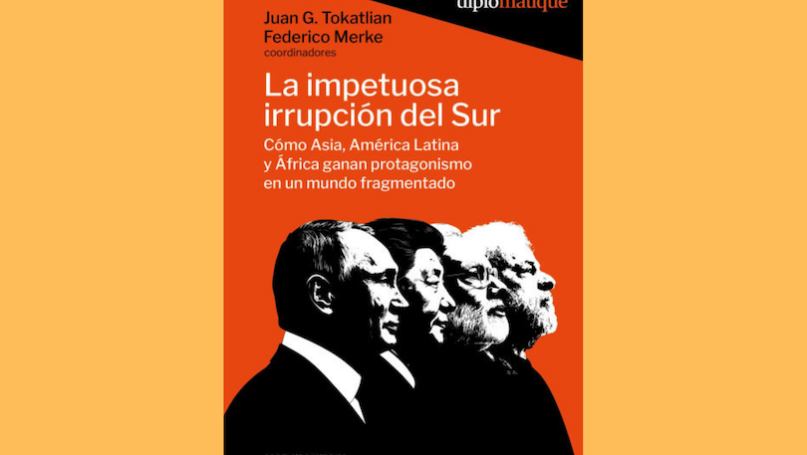
The Impetuous Rise of the Global South: How Asia, Latin America, and Africa Are Gaining Prominence in a Fragmented World [originally in Spanish]
Edited by Juan Gabriel Tokatlian and Federico Merke
Siglo XXI Editores, 2024
“La impetuosa irrupción del Sur: Cómo Asia, América Latina y África ganan protagonismo en un mundo fragmentado,” edited by Argentinian scholars Juan Gabriel Tokatlian and Federico Merke, is a timely and insightful collection that profoundly contributes to the evolving scholarly debate on the concept of the Global South and its role in international relations. The book is written in Spanish, and the title translates to “The Impetuous Rise of the Global South: How Asia, Latin America, and Africa Are Gaining Prominence in a Fragmented World.” It comprises seven essays stemming from a March 2024 workshop by the Universidad de San Andrés and Universidad Torcuato Di Tella, aiming to examine the broad structural trends the Global South is experiencing in international affairs and Latin America’s place within this reconfigured global landscape.
The book positions the Global South not merely as a geographical entity but as a fundamental challenge to traditional conceptions of power and influence in international studies. It highlights how global issues like pandemics, climate change, and digitalization vividly expose persistent asymmetries between the North and the South, underscoring the latter’s shared challenges and vulnerabilities. Instead of offering a rigid definition of the Global South, the authors foster a dynamic dialogue that reflects its multiple economic, political, social, environmental, and cultural dimensions. They view the Global South as an “existing and ascendant social fact” (p. 16), characterized by states sharing challenges like persistent socioeconomic issues, common colonial histories, and often a marginal position in global power structures, reflecting the legacy of “unequal and combined development” (p. 18).
As stated by the editors in the introduction, the book critiques the predominant “Northern” (primarily Anglo-Saxon) interest in the Global South. While there’s a growing recognition in the North of the economic progress of several developing countries and their increasing political relevance in global forums, Northern analysts frequently describe the concept “Global South” as vague, geographically inept, or even deceptive (p. 14).
Conversely, the book emphasizes that a significant portion of the knowledge about the Global South originates from within the Global South itself. It further explores how leaders from the Global South, such as Lula, Modi, Ramaphosa, Xi, and Widodo have mobilized the expression in three different ways: a conservative usage emphasizing economic underdevelopment; a strategic usage promoting political alignment and solidarity, often through South-South cooperation; and an identitarian usage asserting autonomy, identity, and cultural diversity in resistance to Western influence (pp. 14-5).
In Chapter 1, “One South and Two Norths: the new international order”, Bernabé Malacalza identifies three normative ‘cosmovisions’ about how the world should be organized. The Global South’s vision of international order is distinct from those of the “Two Norths” (Western and Eastern), primarily unified by a profound dissatisfaction with the existing international order and a shared aspiration for empathy, justice, and equity. This vision is rooted in precolonial histories and the traumatic experiences of colonialism, manifesting as a commitment to international peace, resistance to foreign interventions and imposition of hegemony, defense of sovereignty and the right to development, and a continuous pursuit of social justice and global equity (p. 44).
Esteban Actis authors Chapter 2, “Geopolitics of the Global South and the ‘forgotten land’ of Latin America”. He builds on the tension between the Global South and the ‘two Norths’, represented by the United States and China. He claims that power as autonomy (as opposed to the traditional view of power as influence) is a common trait that brings the Global South together. That explains the Global South’s assertive stance in various global discussions, from WTO negotiations and climate change financing to equitable vaccine access during the COVID-19 pandemic. The Global South’s quest for autonomy also sheds light on why many countries are increasingly adopting “hedging” strategies, which involve maintaining flexibility, keeping communication channels open with all major powers, and avoiding costly entanglements or firm commitments (p. 67). This differs from Cold War non-alignment by focusing on specific, often temporary, coalitions of convenience rather than durable alliances.
Chapter 3, “Peace and Conflict”, brings Andrea Oelsner’s assessment on the state of conflicts in the Global South. She argues that there has been an expansion of violence across Africa and Asia, which overlaps with pre-existing conflicts and a persisting political and institutional fragility. This situation contrasts with Latin America, which has the lowest number of peace operations and a minimal military budget globally, despite concerning patterns of internal violence linked to organized crime (p. 97). Although there are striking differences between the nature and dynamics of conflicts in different parts of the Global South, the author underlines that the sources of insecurity and violence share some common features. These include the extra-regional pressures coming from the North, the weakening of state institutions and societies, and the loss of trust and legitimacy in multilateral mechanisms of conflict resolution (p. 96).
In Chapter 4, “The new routes of international trade: the place of the Global South”, Julieta Zelicovich claims that the concept of Global South, when used as a framework to analyze international trade flows, has few advantages compared to the traditional category of developing countries (p. 111). Whereas the term Global South may be useful to underscore the structural dimension of the distributive effects of trade, as well as to make sense of the power asymmetries in global trade governance (p. 112), short-term commercial trends suggest that there are multiple ‘Souths’ that have to be addressed according to their specificities (p. 124).
The next two chapters look respectively into the policy arenas of technical cooperation and climate change. Chapter 5, Élodie Brun’s “South-South Cooperation, the Latin American imprint, and the moment of disenchantment”, and Chapter 6, Patricio Yamin’s “The Global South before the challenge of climate change”, single out the role (and the contradictions) of emerging countries like China, India, and Brazil in shaping regional and multilateral rules regarding South-South Cooperation (SSC) and the climate change regime. Brun questions the very idea that ‘Global South’ refers to all countries that do not fit in the traditional idea of the North – being a political label rather than an all-encompassing identity – and argues that SSC is part of a Southern project that states selectively adhere to, if at all (p. 134). Yamin, in turn, claims that the Global South is highly heterogeneous when it comes to climate change (p. 148). Major emerging economies like China and India are significant emitters with increasing influence, while many low-income countries are highly vulnerable despite minimal historical contributions to the problem (p. 154). The gap between these groups is widening, particularly concerning the most vulnerable. Shared challenges include dependence on fossil fuels and emissions from agriculture and deforestation (p. 165).
Besides offering a rich and multidimensional debate on the concept of Global South and its political implications, the book highlights Latin America’s challenges in world affairs and its valuable contribution to the emerging role of the Global South.
Monica Hirst writes Chapter 7, “The ‘tired utopia’: dilemmas of Latin American regionalism in the Global South”, which provides a thorough assessment of the region’s foreign policy strategies and how they represent a unique dimension of Global South politics. She understands such uniqueness through the prism of the relationship between Latin America and the two great powers, China and the United States; of the intra-regional dynamics that have produced distinct sub-regions; and of the particularities of Latin America’s positions in the collective forums of the Global South (p. 179). Her chapter reads not only as a competent summary of the previous discussions, but also as a guide for readers who are not familiar with Latin American politics to understand the angle of the book.
While Latin America’s historical ties to the West are complex and often ambivalent, leading some to call it “the other West” or a distinct civilization, Malacaza argues that the region exhibits a singular blend of Western influence, indigenous cultures, and a periphery status (p. 48). Therefore, Latin America has developed distinct diplomatic traditions that inform its engagement with the international order. These include a “liberal internationalism” focused on human rights and democracy, a “republican internationalism” emphasizing state sovereignty, and a “developmental internationalism” promoting economic welfare and reducing North-South inequalities. More recently, “transnationalism” has emerged, advocating for social, gender, interracial, and environmental justice (p. 51).
Actis and Oelsner underscore that one of Latin America’s most significant features is its consistent characterization as a “zone of peace” in terms of interstate conflicts. According to Actis, this explains Latin America’s embrace of innovative foreign policy strategies, such as hedging or active non-alignment, which involve a strategic commitment to the United States while increasing economic ties with China, and seeking diversification in political-diplomatic relations (p. 72). Furthermore, Oelsner emphasizes that Latin America’s voice and experience in peaceful conflict resolution should be welcomed globally (p. 104).
The region’s contributions to the international order are also a major theme for Brun and Yamin. Latin America has shown marked activism in South-South Cooperation (SSC), which is evidenced by the provision of SSC projects by countries like Brazil, Cuba, and Venezuela. The region also boasts a robust academic interest in SSC, contributing to conceptual discussions and monitoring initiatives (pp. 136-37). On the climate agenda, Latin America has opportunities in critical minerals (e.g., lithium, copper) and its relatively clean energy matrix. Brazil’s role as host of COP30 in the Amazonian city of Belém do Pará presents a key leadership opportunity for Latin America and the Global South (pp. 171-73).
Regarding trade, Zelicovich acknowledges that the prospects for Latin America are ambivalent. While intra-regional trade and trade with the rest of the Global South show a more diverse export basket than its trade with Northern economies, Latin America’s overall share in global trade is limited. Moreover, Latin America’s trade outlook remains stagnant, facing complex challenges such as restrictive monetary policies, ongoing conflicts, and the impacts of climate change (p. 123).
The authors present a complex and often challenging outlook for the Global South – and for Latin America. A central theme is the intensified geopolitical fragmentation driven by the rivalry between the United States and China. This dynamic pushes countries toward a “geopolitical recession” and a zero-sum world, making it more difficult for the Global South to assert collective agency. The success of Latin America’s foreign policy strategies in such volatile context is still uncertain (p. 75).
While an active engagement between Latin America and the Global South could offer a path to greater agency in the reconfigured international order, the region currently faces a “tired utopia”. Economic and social crises, de-industrialization, and the digital divide compromise its traditional role in advocating for development and against economic asymmetries. The challenge for Latin America lies in identifying incentives to build sustainable intra-South relationships and coordinate efforts, as its current trajectory offers little impetus to a collective South agenda and risks exacerbating fragmenting dynamics that have thwarted the very development of the Global South to this day.
This book is a required reading for scholars, students, and policymakers who have an interest in the Global South and Latin America. While it does not solve the cacophony around the concept of Global South, sometimes even adding new layers to an already intricate discussion, it sheds light on the unique role of Latin America in the Global South, as well as its important (but often underestimated) contributions to academic and political debates alike. The fact that the book is in Spanish might be an obstacle for a broader audience that might be interested in this discussion, so an English translation is highly recommended.