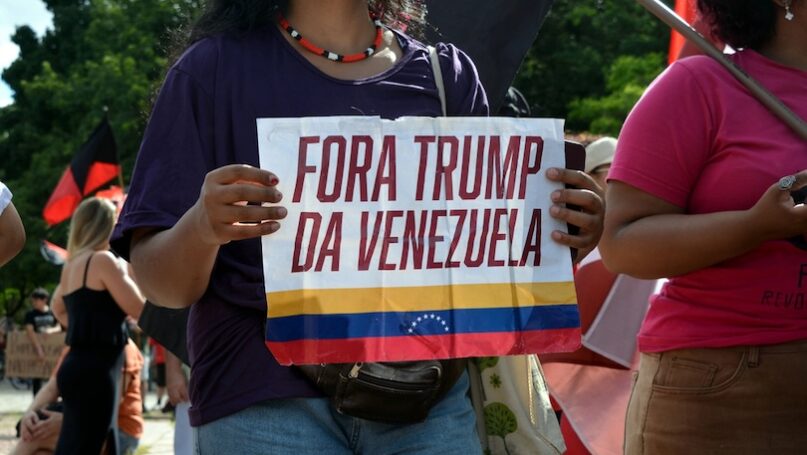
The U.S. assault on Venezuela confirms a long-standing historical pattern: the war on drugs has never ranked high in the actual hierarchy of U.S. foreign-policy priorities. It certainly does not matter in the Venezuelan case. Venezuela is a relatively minor player in global cocaine trafficking, much of which flows to Europe and Brazil rather than to the United States. If drug enforcement were the operative concern, Venezuela would barely register.
What makes this especially jarring is Trump’s pardon of Juan Orlando Hernández, the former Honduran president convicted in a U.S. court on narco-trafficking charges. Ostensibly justified as a gesture toward political stabilization, the pardon functioned more directly as an intervention in Honduran electoral politics. Read together, the release of Hernández and the pursuit of Maduro underscore a deeper pattern: law enforcement is no longer a constraint on executive power but a tool for advancing personalist rule.
Law has become politically fungible. This tendency was already visible during the first Trump administration; in the second, it has become the governing motif. As Bruce Green, a former federal prosecutor and professor of legal ethics at Fordham Law School, observes:
Trump thinks he can use federal criminal prosecutions for any purpose, which is to say to promote his foreign policy views, to promote his vendettas, to promote his self-interest and to promote his perceived political interests.
What this marks is a moment in which law collapses into movement. Law no longer constrains political motion; it accelerates it. In Arendtian terms, this signals a further stage in the conquest of the state by the nation: legal structures are no longer even nominally autonomous but are openly instrumentalized in the service of imperial aggrandizement and executive spectacle.
It did not take long for this aggrandizement to become visible. Journalist Jack Paulson noted in a January 3 Substack post that a recent CIA chief of station in Venezuela, Enrique de la Torre, publicly announced on LinkedIn that his new lobbying firm—founded with former U.S. ambassador James B. Story—was already “working with clients focused on democratic recovery, restored U.S. engagement, and the serious work of rebuilding the country’s energy sector.” The revolving doors linking policy makers and corporate clients are already spinning.
Still, it would be a mistake to let the story collapse into a familiar tale of corporate opportunism. The public face of the intervention is Maduro. The insistence that Maduro and his wife are narco-terrorists does crucial ideological work. It supplies the pretext for intervention, even as Trump’s underlying interest in Venezuelan oil remains obvious. These claims—drug criminality versus oil imperialism—may be empirically inconsistent, but they are affectively compatible.
Narco-trafficking here functions as an affective infrastructure of intervention. It does not need to be true in any rigorous sense; it needs only to resonate. Like the rug in The Big Lebowski, it “really ties the room together.” The deeper logic at work is one of racial modernism: the presumption that non-white societies cannot govern themselves within modernity and must therefore be placed under tutelage. Left to their own devices, the narrative goes, they produce narcotics, corruption, economic collapse, migration, and crime. Intervention thus appears not as domination but as guardianship – an enforced obedience to American command, now stripped even of developmental pretense.
This logic intersects with a point Greg Grandin made on Trump’s interest in annexing Greenland. Imperial expansion, Grandin argues, functions as consolation for Americans trapped in economic precarity. Spectacle substitutes for material improvement. Citizens are invited to revel in the projection of national power and to imagine that they, too, might someday share in the spoils. It is a reactivation of the imperial bargain – but without the post–World War II rhetoric of freedom, development, or collective uplift. That masquerade has ended.
What remains is domination without futurity, for anyone. Except, perhaps, in Trump’s insistence that “everyone will get rich,” maybe even Venezuelans. Seen this way, Venezuela represents not an aberration but a restoration of American movement – movement that now operates almost entirely at the level of representation. Real life remains stagnant; only the spectacle advances. The dynamic recalls the U.S. invasion of Iraq as analyzed in Militainment, but without wall-to-wall media coverage and without the catalyzing trauma of 9/11. That level of mobilization may no longer be necessary.
Americans have been primed by years of economic degradation and social unraveling. Resentment now circulates freely, ready to be projected onto racialized and criminalized figures—Haitians allegedly eating pets in Ohio, or Maduro staged as a grotesque enemy in a show trial. Trump’s wager is that this scapegoating reflex can override public exhaustion with forever wars. If the enemy can be rendered sufficiently racialized, criminalized, and obscene, imperial action need not promise victory, stability, or even resolution. It need only promise domination.
Further Reading on E-International Relations
- Opinion – What Has Trump Got Planned for Venezuela?
- The Diffuse Unilateralism of Trump’s Venezuela Intervention
- Opinion – Venezuela and the Cost of Abandoning South American Collective Defense
- Opinion – The Survival of Venezuela’s Bolivarian Revolution
- Opinion – Venezuela’s Migrants and the Challenges of Trinidad and Tobago
- US-Venezuela Relations in Light of the July Election